

Order Form
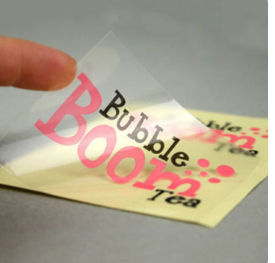
A clear sticker is printed on transparent film, so the surface behind it shows through wherever there is no ink. Applied to glass, a bottle or a polished surface, the design appears to sit directly on the material rather than on a visible patch of white.
It is the right choice for glass jars, bottles, packaging windows and anywhere a background would look wrong. Choose your size, material and quantity below to see live pricing.
Select Your Options – Starting from $80
- Stock
- Shape
- Size
- Quantity
- Price
- Delivery

- Custom Shape Fee
- Sub Total
- GST

- Total (incl. GST)
 Checkout
Not seeing what you're after? Click here for custom quote.

Please be patient, your order will be submitted shortly
How clear stickers work
The film is transparent rather than white. Ink is laid onto it, and anything left unprinted stays see-through. The visual result is a design that belongs to the surface instead of sitting on top of it.
The trade-off is colour. Printing inks are translucent, so without a white base behind them the colour mixes with whatever is underneath. On a light bottle that is often fine and sometimes desirable. On a dark or busy surface, colours look washed out and muddy.
This is where white ink matters. A white layer printed underneath the colours gives them something opaque to sit on, so they reproduce accurately while the unprinted areas stay clear. It costs a little more and it is the difference between a clear sticker that works and one that disappoints.
When to choose clear over white
Choose clear when the surface is part of the design — glass jars, clear bottles, acrylic, polished timber, windows and packaging with a window panel.
Choose white when colour accuracy is critical, when the surface is dark or patterned, or when the design needs to read strongly from a distance.
A useful test: if you would be happy to see the surface through the gaps in your design, clear is right. If the design needs to sit on its own field, white is right.
Surfaces and application
Glass is the ideal surface. It is perfectly smooth, inert and shows a clear sticker at its best. Clean with glass cleaner then wipe with isopropyl alcohol — ordinary cleaners leave a film that stops the adhesive keying, and on a transparent sticker any residue is visible.
Smooth plastics, acrylic and polished metal all work well. Textured and matte surfaces are less suited, because the air gaps under the film show as cloudiness where a white sticker would hide them.
Larger clear stickers are easier applied wet, with a slip solution sprayed on the surface so the sticker can be positioned before being squeegeed down. Expect slight cloudiness for a day or two while the remaining moisture clears — that is normal and it dries out.
Common uses
Glass jars and bottles for food, drinks, candles and cosmetics, where the product should be visible through the label.
Window and shopfront application where the glass must stay transparent around the design.
Packaging seals on clear bags and boxes.
Premium product branding where a visible white edge would cheapen the look.
Laptops, phone cases and personal items where the surface finish is part of the appeal.
Frequently asked questions
Are clear stickers completely invisible where unprinted?
Nearly. The film itself is very slightly visible at the edge on close inspection, particularly against a strong light. At normal viewing distance on glass or a bottle it reads as though the design is printed directly on the surface.
Do I need white ink?
If your design has defined colours that need to look right, yes. Without a white base the ink mixes with the surface behind it. On a light surface with a simple design you can often go without; on anything dark or patterned, white ink is essential.
Will they work on a dark surface?
Only with a white base under the colours. Without one, printed colours on clear film sink into a dark background and the design looks muddy and washed out.
Are clear stickers waterproof?
Yes, when printed on clear vinyl. They handle bottles, jars, refrigeration and outdoor exposure. Paper stock is not available as a clear option, so a clear sticker is a vinyl product by definition.
Can I use them on windows?
Yes, and it is one of the most common uses. Clear film keeps the glass transparent around the design. For interior application the artwork is reversed so it reads correctly from outside — tell us which side it is going on.
Why does my clear sticker look cloudy after applying?
If applied wet, trapped slip solution takes a day or two to clear and the cloudiness disappears. If it persists, it is usually air trapped against a textured surface, or residue left on the surface before application.
Can I have a white border?
Yes. A printed white outline or background shape can be included in the artwork, giving you a defined edge while the rest of the sticker stays clear.
Do they come off glass cleanly?
Yes. Warm gently, lift a corner and pull back at a shallow angle. Any residue removes with isopropyl alcohol. Use a plastic scraper rather than a blade on glass.
What shapes are available?
Any. Die-cutting follows your artwork outline. On clear film the cut line is less visible than on white stock, which is part of the appeal.
What artwork do you need?
Vector files are ideal. Importantly, tell us which elements should be white-backed and which should stay transparent — that is a decision we cannot make for you from the file alone.